admin
admin 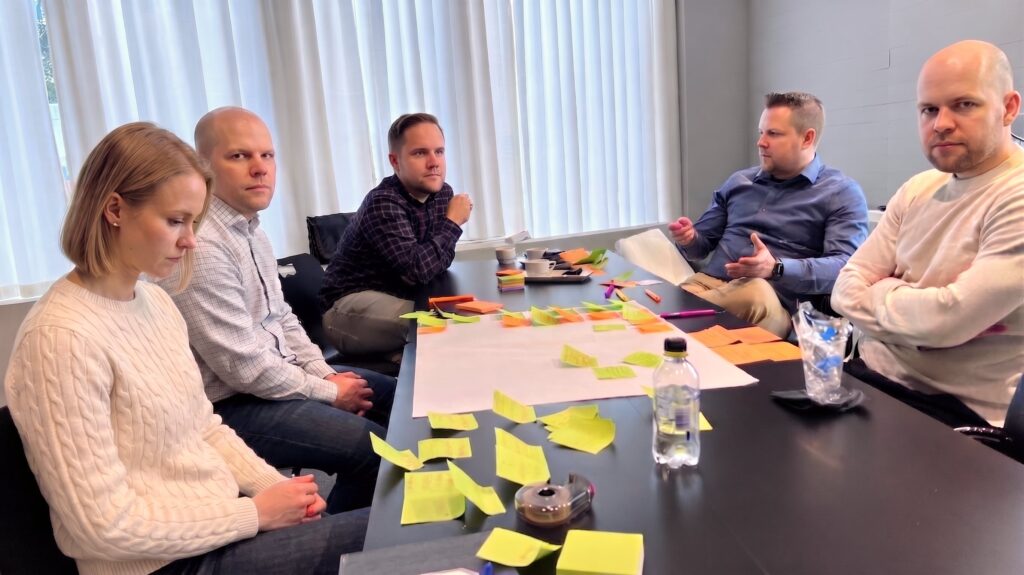
Most AEC professionals learn to work in teams and across teams through trial and error. There are, however, opportunities to better prepare for the real world with formal training. Until now, it has required human facilitators. Now, generative AI is emerging as a scalable alternative, which I’m also exploring.
A gap in curricula
When I studied architecture, most of the teamwork happened with co-students in the same department. However, one course focused on industrial projects where future architects and engineers collaborated on a simulated project. I’m not sure if a similar course is still in the curriculum, but it was certainly worthwhile and should have been much more extensive.
The university did not really prepare me to collaborate in high-stakes, multi-million-euro projects. The real learning happened while working on real projects at architecture companies, which many students of at least my generation did alongside their studies.
Maybe the lack of training is one of the reasons AEC professionals struggle to understand the perspectives and needs of other project participants. They often view others as adversaries rather than partners. “Architects understand everything but know nothing; construction supervisors know everything but understand nothing” is an apt anecdote I once heard from a colleague.
Training for human collaboration is hard
Construction is a people business, yet it’s taught as if it were purely industrial production. It’s easier to offer technical and workflow education, BIM certifications, and ISO 19650 training than to teach soft skills and build a collaborative mindset.
Improving soft skills and communication is not as straightforward. It requires human facilitators who are well-versed in human psychology and how construction projects work.
I have not found broad collaboration or teamwork training built for construction. What exists tends to be general business coaching, or negotiation training that has to be adapted to our context.
An alternative: AI-powered training
Unlike static eLearning modules or role-playing exercises that require human facilitators, AI-powered simulators are emerging as an alternative. They provide realistic, on-demand practice scenarios for negotiation, conflict resolution, and team communication.
You can build an agentic system that mimics human behavior and invite people from different professions to interact with the agents. If you’re an architect, agents can play the roles of engineers, clients, authorities, etc. They can be taught to have various personal backgrounds and characteristics.
A collaboration simulator would be a hybrid of two technologies: behavioral models to control stable traits and decision rules, and LLMs to generate natural conversation and adaptation.
Commercial applications already exist
Generative AI collaboration training is still new, but a few companies are already offering it, mostly not for construction. The closest to construction-specific comes from South Korea, where negoconsulting.com has been running negotiation training since 2003 and now folds an AI negotiation coach into its programs, including one for construction. The AI mainly supports preparation, strategy, and feedback rather than replacing the human trainer.
AI interaction is not limited to text. CareerTrainer.ai lets users practice live audio conversations with AI personas and get immediate feedback. It is built for sales and leadership rather than construction, but the same voice role-play could rehearse subcontractor negotiations or supplier escalations.
The Edge Negotiation Group launched Deal/Spar in June 2026, an AI-powered negotiation simulator that supports text, voice, and video interactions. Users practice with realistic AI counterparts that exhibit a range of negotiation styles: auctions, hard bargaining, concession trading, win-win scenarios, and high-dependency situations. Although not construction-specific, it is designed for complex B2B negotiations and could be adapted for construction scenarios such as change orders, subcontractor disputes, or owner-architect negotiations.
The examples are still early adoptions, and I don’t have customer feedback on their effectiveness. However, I’m confident the coaching industry will catch on with generative AI’s potential soon.
The near future
Having worked in traditional training and e-learning for years, I now explore the possibilities of AI. My company is developing a new AI-powered training platform, so I have a stake in where this goes.
I expect AI to become a standard layer in most training this decade, collaboration training included. Learners will interact with realistic role-playing avatars and personal coaches that will guide their professional lives from studies onward.
The examples above train people to negotiate. The stranger shift is AI agents that negotiate on our behalf in bidding, procurement, and contract talks, with other agents across the table. I can’t say how fast that arrives or how far it goes, but it does not make human collaboration matter less. It changes what the skill is: learning to work across humans and machines, not only human to human, becomes the thing worth practicing.